An Alchemy of Mind by Diane Ackerman
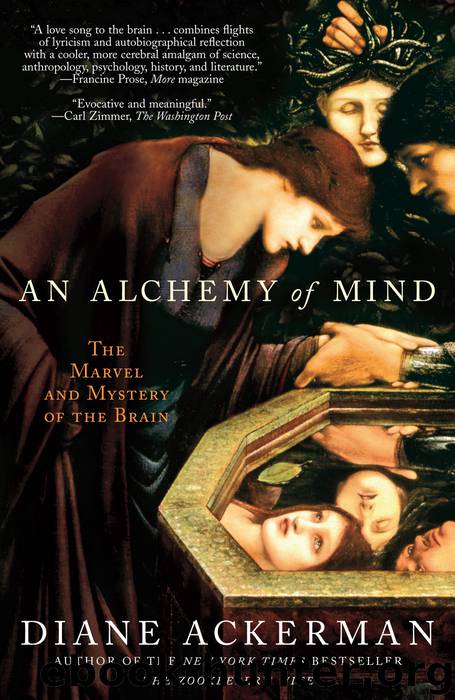
Author:Diane Ackerman
Language: eng
Format: epub
Publisher: Scribner
CHAPTER 23
“Shall It Be Male or Female? Say the Cells”
Shall it be male or female? say the cells, And drop the plum like fire from the flesh.
—Dylan Thomas,
“If I were tickled by the rub of love”
When I was on French Frigate Shoals, home to the world’s remaining monk seals, we doctored a female whose tail had been cropped by a shark. She was flown to a Hawaiian seaquarium for care, because with precious few female monk seals left in the world, losing even one is tragic. We tend to picture humans as teeming masses, a single organism quickly swallowing the planet. But once we were as scarce and endangered as monk seals, a hairsbreadth from extinction. We know this because all the people on Earth can trace their genes back to a handful of common ancestors. That’s why we’re much more closely related to each other than, say, chimpanzees are to one another. At some ominous stage of evolution, we dwindled to perhaps a hundred humans, and among those, some would have produced only daughters who didn’t survive long enough to reproduce, so their genetic line died out. Those must have been extraordinary beings, hopeful and resilient, with a furious life force and enough brains to outwit their enemies and environment, endure brutal trials, endless indignities, and yet raise strong children. Why does resiliency surprise us? We are born survivors.
Evolution plays no favorites; men and women both animate a tribe of genes. Inheritors, we all possess similar-looking brains. Simply because women tend to be physically smaller than men, women’s brains are 10 to 15 percent lighter, housing fewer neurons, but those seem to have more connections. That rich connectedness may help explain why women are more prey to depression. Studies show that women ruminate more about emotional things. Some say that women aren’t more vulnerable to depression, only more comfortable asking for help. In subtle ways, men’s and women’s brains are wired differently. About five people in a thousand experience synesthesia, for instance, but over 75 percent of those are women. Females tend to be better at what’s now called multitasking, a word like a breakfast cereal full of fiber. How about spatially? Show me a simple object and I have trouble drawing its unseen side. Although I have a good visual memory, when I try to picture three-dimensional objects in space my mind’s eye goes blank. As a result, it took me longer than male student pilots to learn how to land airplanes, an abstract spatial exercise, especially at night. For ages, it seemed, I landed like tripping over toys in the darkness. I finally managed it in a roundabout way by devising my own private geometry: when those lines are like that, and the runway is there, and trees and buildings look like that, then I’m at this altitude. Another good trick: if the runway seems to be sliding up the window, I’m too low; if it’s sliding down the window, I’m too high. Several things may explain
Download
This site does not store any files on its server. We only index and link to content provided by other sites. Please contact the content providers to delete copyright contents if any and email us, we'll remove relevant links or contents immediately.
Sapiens: A Brief History of Humankind by Yuval Noah Harari(14361)
The Tidewater Tales by John Barth(12649)
Mastermind: How to Think Like Sherlock Holmes by Maria Konnikova(7315)
Do No Harm Stories of Life, Death and Brain Surgery by Henry Marsh(6933)
The Thirst by Nesbo Jo(6925)
Why We Sleep: Unlocking the Power of Sleep and Dreams by Matthew Walker(6694)
Life 3.0: Being Human in the Age of Artificial Intelligence by Tegmark Max(5543)
Sapiens by Yuval Noah Harari(5363)
The Body: A Guide for Occupants by Bill Bryson(5078)
The Longevity Diet by Valter Longo(5057)
The Rules Do Not Apply by Ariel Levy(4956)
The Immortal Life of Henrietta Lacks by Rebecca Skloot(4571)
Animal Frequency by Melissa Alvarez(4459)
Why We Sleep by Matthew Walker(4433)
The Hacking of the American Mind by Robert H. Lustig(4373)
Yoga Anatomy by Kaminoff Leslie(4355)
All Creatures Great and Small by James Herriot(4306)
Double Down (Diary of a Wimpy Kid Book 11) by Jeff Kinney(4257)
Embedded Programming with Modern C++ Cookbook by Igor Viarheichyk(4170)
